Three Ways This Can End
Your ballot asks two yes/no questions. How you and other stockholders vote on them will dictate one of three mutually exclusive outcomes. Every one of them is a conservation outcome — none puts the forest at risk of development. They differ in how protection works, who stewards the land, and what the community gains or gives up.
Outcome 1
A conservation easement
Question 1 on your ballot · Resolution 07-18-2025(B) · YES on 1, NO on 2
The Chautauqua keeps legal title but permanently and irrevocably gives up the right to develop the parcel or sell it free of restrictions. Lebanon Valley Conservancy holds and enforces the easement forever, with no payment to the Chautauqua.
Outcome 2
A conservation sale
Question 2 on your ballot · Resolution 07-17-2026 · NO on 1, YES on 2
The Chautauqua permanently gives up ownership of approximately 15 acres, selling to Natural Lands Trust, Inc. for approximately $600,000, contingent on Natural Lands securing grant funding. The water and well area is excluded and stays with the Chautauqua.
Outcome 3
Neither
Neither question passes · NO on both
The Chautauqua keeps full ownership under existing arrangements and continues its volunteer-led, professionally guided stewardship of the woodland. This is what happens if neither question receives a majority — there is no separate ballot line for it.
“Neither” is not “nothing.” Stewardship continues either way — and nothing prevents stockholders from directing additional protections in the future.
The three outcomes, side by side
The same comparison you received in the mailed Plain Language Summary, in one place. Scroll sideways on a phone to see all three columns.
| Easement YES on Q1, NO on Q2 |
Sale to Natural Lands NO on Q1, YES on Q2 |
Keep the land NO on both |
|
|---|---|---|---|
| What happens to the parcel | The Chautauqua keeps legal title but grants Lebanon Valley Conservancy a permanent easement. The parcel can never be developed and can be sold only subject to the easement. | Ownership transfers to Natural Lands Trust, Inc., a conservation nonprofit. The likely ultimate holder is the Pennsylvania Game Commission. | The Chautauqua continues to own the parcel under existing arrangements. This is what happens automatically if neither question receives a majority. |
| Cash the Chautauqua receives | $0 | Approximately $600,000, contingent entirely on Natural Lands securing grant funding. Proceeds would join the investment account — roughly $24,000/year under the 4% draw policy, without assessments or fundraising. | $0 |
| Development rights | Extinguished permanently by the easement. | Transferred to Natural Lands. If DCNR funds the purchase, a perpetual non-conversion restriction is recorded with the deed — no development, ever, under any owner. | Retained by the Chautauqua. |
| Current appraised value | $847,000 (highest-and-best-use as residential lots, per the December 2025 appraisal). | $847,000 (same appraisal). The $600,000 sale price is about $247,000 below appraised value. | $847,000 (same appraisal). |
| Value after action, and use as loan collateral | Substantially reduced. With residential construction prohibited, the parcel could no longer serve as meaningful loan collateral. | Not applicable — the parcel is no longer owned. | Unchanged at $847,000, and available as collateral if ever needed. |
| Federal tax benefit to the Chautauqua | None. As a 501(c)(4), the Chautauqua cannot take the charitable deduction that normally benefits easement donors. | None. The Chautauqua cannot deduct the difference between sale price and appraised value. | Not applicable. |
| Annual property tax | About $47.54/year continues. | None — the property is no longer owned. | About $47.54/year continues. |
| Long-term steward | The Chautauqua, under easement restrictions monitored by Lebanon Valley Conservancy, working with a woodland steward (currently Wilson Alvarez). Funded by the restricted $200,000 stewardship gift. | Natural Lands, with the Pennsylvania Game Commission the likely ultimate holder. PGC practices active wildlife management, including timbering, treatment of invasive species, and hunting. Its local overseer has said he would welcome an ongoing Chautauqua stewardship role, though neither the transfer nor that role is guaranteed. | The Chautauqua, working with a woodland steward (currently Wilson Alvarez), funded by the restricted $200,000 stewardship gift. |
| Future flexibility | Permanently restricted. The parcel cannot be developed; it could be sold only to a buyer who accepts the easement. | None — the parcel is no longer owned. | Fully preserved. Any future sale or encumbrance would require a stockholder vote with a 66% quorum under Article VI, Section 4(a). |
| Counterparty | Lebanon Valley Conservancy, a nonprofit land trust in Lebanon County. | Natural Lands Trust, Inc., a regional conservation nonprofit — the immediate buyer. The likely ultimate holder is the Pennsylvania Game Commission. | None. |
If both questions were to pass, the two outcomes cannot both happen — the Board would convene a follow-up stockholder meeting to choose between them. How to mark your ballot for each outcome →
How the remote vote works
Because this is a mailed vote rather than an in-person gathering, there's no one in the room to answer a question as you mark your ballot. So here is everything the enclosed instructions cover — plus additional details to help inform your decision, and illuminate the process.
Your ballot asks two separate yes/no questions about the same parcel. Because only one of the two can actually happen, you mark YES or NO on both — that combination is what records your preference:
- Want the conservation easement? Mark YES on Question 1 and NO on Question 2.
- Want the sale to Natural Lands? Mark NO on Question 1 and YES on Question 2.
- Want the Chautauqua to keep the land as is? Mark NO on both questions.
See what a correctly marked ballot looks like
Pick the outcome you'd want, and the sample ballot below fills in to match. Nothing here is submitted — it's only a preview.
The Chautauqua keeps legal title but permanently and irrevocably gives up the right to develop the parcel or sell it free of restrictions. Lebanon Valley Conservancy holds and enforces the easement forever. No payment to the Chautauqua. Unlike keeping the land, this choice cannot be undone by a future stockholder vote.
Mark YES here only if you want the easement.
The Chautauqua permanently gives up ownership of approximately 15 acres, selling to Natural Lands Trust, Inc. (Natural Lands) for approximately $600,000, contingent on Natural Lands securing grant funding. The water and well area is excluded and stays with the Chautauqua.
Mark YES here only if you want the sale.
An Abstain (or a blank question) counts toward the quorum but is not a vote cast — if you have a view, YES or NO is how it gets counted.
You have two ballots — return both
Each property holds two shares, so your envelope contains two ballots, labeled Ballot 1 of 2 and Ballot 2 of 2. Return both — even if you mark them identically. They are counted as the separate votes of your two shares. A stockholder who owns multiple properties still holds two shares in total and submits only two ballots.
Sign, or it isn't counted
Every ballot must be signed on the signature line. Any owner of record for the property may sign; an entity signs through its designated representative. Your signature certifies that you're entitled to vote and that the marks are your own. Unsigned ballots are not counted.
How votes are counted
Each question is counted separately, exactly as you mark it. A question passes if it receives a majority of the votes cast on it (excluding abstentions), provided the quorum is met. The two outcomes can't both happen; in the unlikely event both pass, the Board convenes a follow-up meeting to choose between them.
280 votes needed for a quorum
Because this vote concerns real estate, Article VI, Section 4(a) requires participation of at least 280 votes — 66% of all shares. Every properly returned ballot counts toward the quorum, however it's marked — including all-Abstain ballots. That's why returning your ballots matters even if you're undecided: the vote can't happen at all unless enough of us take part.
How and when to return your ballots
All deadlines come from Article VI, Section 5 of the Charter and By-Laws. Whichever way you return them, sign both ballots first.
-
Drop slot · simplest
Secure drop slot at the Chautauqua office, 101 Chautauqua Drive. Deposit both ballots by 4:00 PM, Saturday, October 3.
-
Mail · earliest deadline
Mail to P.O. Box 637, Mount Gretna, PA 17064. Must be postmarked by Wednesday, September 30 — three days before the deadline. Mail early; later postmarks cannot be counted.
-
Email
Email to Chautauqua_Secretary@pachautauqua.org by 5:00 PM, Saturday, October 3. Sign the paper ballots first, then photograph or scan each signed ballot and attach the images. The email must come from the address on file for your stockholding — ballots from any other address cannot be counted. If your contact information has changed, update it with the office before voting.
-
In person
In person at the Chautauqua Boardroom, Saturday, October 3, 12:00–5:00 PM.
Questions about procedure or ballot mechanics? Email the Chautauqua Secretary at Chautauqua_Secretary@pachautauqua.org. Questions about the substance of the two options are what the rest of this site — and the FAQ — are for.
The official materials
The full, verbatim text of both resolutions is reproduced below. The appraisal, the parcel map and platting, and prior meeting minutes are available from the Chautauqua office; the parcel map also appears in the FAQ.
Full text — Resolution 07-18-2025(B): the conservation easement
PENNSYLVANIA CHAUTAUQUA — RESOLUTION NUMBER 07-18-2025(B)
DIRECTING THE EXECUTION OF A CONSERVATION EASEMENT WITH THE LEBANON VALLEY CONSERVANCY
A resolution by the Stockholders of the Pennsylvania Chautauqua at its Annual Meeting on July 18, 2025.
WITNESSETH:
1. WHEREAS, the Pennsylvania Chautauqua Stockholders, at its duly authorized annual meeting on July 21, 2023 adopted Resolution 07-21-2023(A) authorizing the Pennsylvania Chautauqua Board of Managers (BOM) to explore the granting of a Conservation Easement for lands of the Pennsylvania Chautauqua to the Lebanon Valley Conservancy which property containing approximately 18 plus acres consisting of the following (collectively the Southern Woodlands):
a. A portion of lands along proposed unopened Albright Avenue, proposed unopened Old Mountain Road, and proposed unopened Muhlenberg Avenue southerly to the Pennsylvania State Game lands; and
b. A portion of unopened land from the intersection of unopened Albright and unopened Muhlenberg Avenues and southerly to the Pennsylvania State Game lands and extending westwardly along the Pennsylvania State Game Lands to State Avenue;
c. Approved expenditures for survey costs and appraisal of the subject property in consideration of the granting of the easement;
d. A copy of Resolution Number 07-21-2023(A) is attached hereto and incorporated herein as if fully set forth.
NOW, THEREFORE, it is hereby resolved by the Pennsylvania Chautauqua Stockholders and it is hereby resolved by the authority of the same as follows:
1. The WHEREAS clause set forth above is incorporated herein by reference as if fully set forth.
2. The Stockholders of the Pennsylvania Chautauqua do hereby direct the BOM to grant and record a Conservation Easement for the lands of the Pennsylvania Chautauqua to the Lebanon Valley Conservancy as set forth herein:
a. Complete a land survey of the Southern Woodlands with a Pennsylvania registered surveyor to be completed no later than March 31, 2026;
b. Upon completion of the survey prepare, finalize, execute, and record a written Conservation Easement of the approved surveyed lands to the Lebanon Valley Conservancy no later than June 30, 2026 on a form acceptable to the Lebanon Valley Conservancy;
c. Coordinate with the Mount Gretna Authority to ensure its infrastructure needs regarding water service now provided to the Mount Gretna community are addressed, including consideration of any costs to be paid to the Mount Gretna Authority for any survey and legal costs incurred;
d. Authorizing up to an additional $15,000.00, less any funds received from outside sources, to cover all expenses, including survey costs, attorney fees and costs, and costs incurred by the Lebanon Valley Conservancy to complete the Conservation Easement.
Adopted this 18th day of July, 2025.
Note: Resolution 07-21-2023(A), the enabling resolution incorporated by reference above, is available from the Chautauqua office. At its August 29, 2026 meeting, the Board interpreted the survey and execution deadlines above — which have passed — as directing prompt execution following stockholder adoption; this interpretation is recorded in the minutes.
Full text — Resolution 07-17-2026: the sale to Natural Lands
PENNSYLVANIA CHAUTAUQUA — RESOLUTION NUMBER 07-17-2026
AUTHORIZING THE SALE OF APPROXIMATELY 15 ACRES KNOWN AS THE SOUTHERN WOODLANDS TO NATURAL LANDS TRUST, INC., d/b/a NATURAL LANDS, A NON-PROFIT CORPORATION (NATURAL LANDS)
A resolution by the Stockholders of the Pennsylvania Chautauqua at its Annual Meeting on July 17, 2026.
WITNESSETH:
1. WHEREAS, Natural Lands is a non-profit organization that preserves and saves open space from development and preservation of the land, cares for nature, and connects people to the outdoors; and
2. WHEREAS, the Pennsylvania Chautauqua (Chautauqua) received a proposed Agreement of Sale from Natural Lands to purchase approximately 15.40 acres known as the Southern Woodlands for $600,000.00 with a possible price adjustment based upon the total acreage; and
3. WHEREAS, the net proceeds of a sale be deposited into the Chautauqua Investment account with the ability to withdraw four percent (4%) per year as is the present policy with the ability to withdraw for preservation, maintenance, and improvements of Chautauqua's historic buildings and stewardship of Chautauqua's historic grounds; and
4. WHEREAS, the Southern Woodlands contains approximately 15 acres consisting of the following:
1. A portion of lands along proposed unopened Albright Avenue, proposed unopened Old Mountain Road, and proposed unopened Muhlenberg Avenue southerly to the Pennsylvania State Game Lands; and
2. A portion of unopened land from the intersection of unopened Albright and unopened Muhlenberg Avenues and southerly to the Pennsylvania State Game Lands and extending westwardly along the Pennsylvania State Game Lands to a point to be determined by a survey.
5. WHEREAS, the purchase by Natural Lands is contingent upon it obtaining grants and/or funding to fund the purchase price set forth herein; and
6. WHEREAS, any sale of lands owned by the Pennsylvania Chautauqua is required to be approved by a majority vote of sixty-six percent (66%) of its Stockholders attending a regular and/or Special Meeting of the Stockholders; and
7. WHEREAS, the recorded Easements located on the Property to the Mount Gretna Authority for purposes of continuing and operating water facilities for the benefit of the Mount Gretna Community shall continue after the sale.
NOW, THEREFORE, it is hereby RESOLVED by the Pennsylvania Chautauqua Stockholders and it is hereby RESOLVED by the authority of the same as follows:
1. The Whereas clauses set forth above are incorporated herein by reference as if fully set forth.
2. Sixty-six percent (66%) of the Stockholders of the Chautauqua attended the meeting of July 17, 2026.
3. The Stockholders of the Pennsylvania Chautauqua do hereby approve the sale of the Southern Lands to Natural Lands and Trust, Inc. as set forth in the Whereas clauses in Section 1.
4. The net proceeds of the sale be deposited and used as set forth in the Whereas clauses in Section 1.
5. The appropriate Chautauqua Board of Manager Officers are hereby authorized to sign a Deed transferring said property to Natural Lands as land conservation of open space and woodland.
Adopted this 17th day of July, 2026.
Board interpretive note: Resolved clause #2 recites that 66% of stockholders attended the July 17, 2026 Annual Meeting. In fact the required quorum was not present — which is why the resolution now comes to a remote vote under Article VI, Section 11. The recitation reflects the drafters' expectation at the time and does not affect the operative direction of the resolution.
How we got here
Years of knowledge-sharing, fact-finding, and community dialogue — leading to the remote stockholder vote that closes Saturday, October 3, 2026.
2023
The starting point
At the annual meeting, stockholders approved a resolution authorizing the board to explore granting a conservation easement to the Lebanon Valley Conservancy. Everything on this timeline flows from that authorization.
2024
Easement discussions begin
The community starts weighing conservation-easement options for the Southern Woodlands.
July 2025 · Annual Meeting
Resolutions tabled; "Neither" added; quorum bylaw passed
Stockholders vote 173–60 to add "Neither" to the ballot, then table Resolutions A and B to 2026. They also approve a 66% quorum requirement for real-estate transactions and direct the Grounds & Trees Committee to launch a stewardship program.
Late 2025
Stewardship program launches; $200,000 gift
Volunteer-led stewardship begins with professional guidance. An anonymous $200,000 gift, designated for woodland stewardship, generates roughly $8,000 a year under the 4% draw policy.
February 2026
Appraisal and the three-paths framework
A full-parcel appraisal comes in at $847,000. A two-part Chautauqua Talk update lays out the three-paths framework for the decision ahead.
April 2026
Community dialogue session
Structured small-group dialogue, building on the polarity-mapping sessions that preceded last year's meeting.
June 11, 2026
The Natural Lands offer arrives
Natural Lands offers $600,000 for approximately 15 acres, excluding the water and well area, contingent on grant funding.
June 17, 2026
Resolution 07-17-2026 filed
The sale resolution is filed to preserve the community's optionality — nothing sells without a stockholder vote.
Early July 2026
The deed-restriction answer, and Southern Woodlands Decision Navigator launched
Natural Lands confirms it does not take added deed restrictions — including the requested no-cut buffer. We report the news and launch this site.
July 13, 2026
Game Commission conference call
The board spoke directly with the Pennsylvania Game Commission about how it manages land adjacent to homes and within source-water areas — timber, habitat, and public access. Outcomes reported in Chautauqua Talk, differentiating promises, probabilities, and practices.
July 17, 2026 · Annual Meeting
Quorum not reached — no vote could be held
Both resolutions were on the agenda, but real-estate decisions require participation of at least 66% of shares — roughly 280 votes — under Article VI, Section 4(a). That quorum was not achieved at the Annual Meeting, so neither resolution could be voted on.
July 27, 2026 · Stockholder petition
44 stockholders petition for a remote vote
Forty-four stockholders exercised their right under Article VI, Section 11 to petition for a remote vote on the two resolutions. The Board is required by the By-Laws to schedule that vote and distribute a notice packet.
August 2026 · Preparing the ballot
Getting the ballot right
A clear takeaway from board and community dialogue: The greatest threat to the integrity of the process — and to community alignment with the outcome — is confusion about what stockholders are voting on, and how to mark their ballots correctly. (Challenging, since the petition calls for two votes to determine one of three outcomes.) As follow-up, board members worked together to develop the ballot and materials, then tested and refined them through multiple rounds with volunteers. The results are reflected in the packet sent to stockholders — and on this site.
September 2026 · Ballots mailed
Notice packet and ballots go out
Every stockholding receives the Plain Language Summary, the full resolution text, ballot instructions, and two ballots — along with the QR code and link to this site.
October 3, 2026 · Vote closes
Deadline to return your ballots
Stockholders decide among the three outcomes by mailed ballot — an easement, a sale, or neither. Quorum — 280 votes — must be met, and every returned ballot counts toward it, so returning your ballots is decisive. See How to Vote for deadlines by return method.
Frequently asked questions
Organized the way you'll actually encounter the decision. It's long — because your questions were. Built to be skimmed: find your question, read that answer, ignore the rest.
Section 1 — The decision before you
Where exactly are the Southern Woodlands we're talking about?
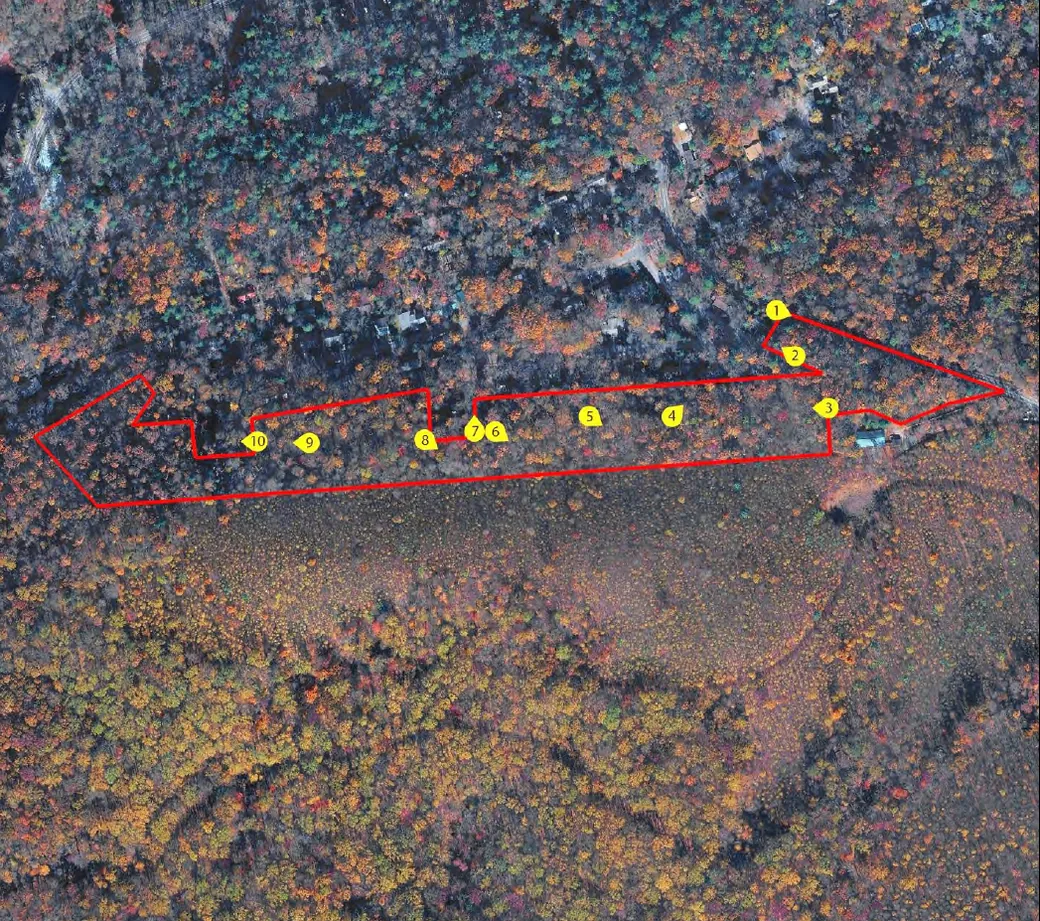
Fair question — and one we heard more than once during the community dialogue. The roughly 15 acres sit at the southern edge of the Chautauqua, adjacent to State Game Lands 145. The map from the Natural Lands appraisal shows the parcel boundaries. An easier-to-read map is available on Grassroots Gretna — credit to Deb Simpson for producing it. On her map, you'll notice olive-green blocks inside the woodlands: those are the ghost of streets platted decades ago and never built, from earlier eras when development of these woods was proposed and, each time, turned back.
What exactly am I voting on?
A stockholder petition requires the Board to put two resolutions before you. They concern the same parcel, so only one can happen:
Question 1 — Resolution 07-18-2025(B): Grant a permanent conservation easement to the Lebanon Valley Conservancy, with no payment to the Chautauqua. The Chautauqua keeps legal title but permanently gives up the right to develop or freely sell the parcel; the Conservancy holds and enforces the easement forever.
Question 2 — Resolution 07-17-2026: Sell approximately 15 acres to Natural Lands Trust, Inc. for approximately $600,000, contingent on Natural Lands securing grant funding. The water and well area is excluded and stays with the Chautauqua.
If neither passes, the Chautauqua keeps the land under existing arrangements. There's no separate ballot line for that outcome — it's simply what happens if both questions fail. The full, verbatim text of both resolutions is in The official materials.
How do I mark my ballot for the outcome I want?
Your ballot asks the two questions separately. Mark YES or NO on both:
- Want the conservation easement? Mark YES on Question 1 and NO on Question 2.
- Want the sale to Natural Lands? Mark NO on Question 1 and YES on Question 2.
- Want the Chautauqua to keep the land as is? Mark NO on both questions.
You can see exactly what each of these looks like on a marked ballot in the How to Vote section — pick an outcome and the sample ballot fills in to match.
An Abstain (or a question left blank) counts toward the quorum but is not a vote cast. If you have a view, YES or NO is how it gets counted.
Why is this a mailed vote instead of a vote at the meeting?
Both resolutions were on the agenda at the July 17, 2026 Annual Stockholders' Meeting. Under Article VI, Section 4(a) of our By-Laws, real-estate decisions require the participation of at least 66% of stockholders — approximately 280 votes. That quorum was not achieved at the Annual Meeting, so neither resolution could be voted on.
On July 27, 2026, 44 stockholders exercised their right under Article VI, Section 11 to petition for a remote vote on these two resolutions. The Board is required by our By-Laws to schedule that vote and distribute the notice packet — which is what arrived in your mailbox, and what this site accompanies.
What's the quorum, and why should I return my ballot even if I'm undecided?
Because this vote concerns the sale or encumbrance of real estate, Article VI, Section 4(a) requires participation of at least 280 votes — 66% of all shares. Every properly returned ballot counts toward the quorum, however it is marked — including all-Abstain ballots.
That's the practical reason to return your ballots even if you haven't made up your mind, or even if you'd rather abstain: The vote cannot happen at all unless enough stockholders take part. Last time, the quorum wasn't reached and no decision could be made. A returned ballot is what makes a decision possible; how you mark it is up to you.
How are the votes counted, and what if both questions pass?
Each question is counted separately, exactly as you mark it. A question left blank is treated as an Abstain on that question. An Abstain counts toward the quorum but is not a vote cast. A question passes if it receives a majority of the votes cast on it (excluding abstentions), provided the quorum is met.
The two outcomes cannot both happen. In the unlikely event both questions receive majorities, the Board will convene a follow-up stockholder meeting to choose between them.
Why did I get two ballots, and do I have to sign them?
Two ballots: Each property holds two shares, so your envelope contains two ballots, labeled Ballot 1 of 2 and Ballot 2 of 2. Return both — even if you mark them identically. They're counted as the separate votes of your two shares. A stockholder who owns multiple properties still holds two shares in total and may submit only two ballots.
Signing: Yes. Every ballot must be signed on the signature line. Any owner of record for the property may sign; an entity signs through its designated representative. Your signature certifies that you're entitled to vote and that the marks are your own. Unsigned ballots are not counted.
The four ways to return your ballots, and the deadline for each, are in the How to Vote section.
The easement resolution's deadlines have already passed, and the sale resolution says 66% attended — what's going on?
Both are addressed in the Board's interpretive notes, recorded in the minutes of its August 29, 2026 meeting, and both are matters of wording rather than substance:
Deadlines in Resolution 07-18-2025(B). The resolution as drafted directs a survey by March 31, 2026 and execution by June 30, 2026. Those dates have passed. The Board formally interpreted these deadlines as directing prompt execution following stockholder adoption.
Attendance recitation in Resolution 07-17-2026. Resolved clause #2 states that 66% of stockholders attended the July 17, 2026 Annual Meeting. In fact the required quorum was not present — which is exactly why the resolution now comes to a remote vote under Article VI, Section 11. The recitation reflects the drafters' expectation at the time and does not affect the operative direction of the resolution.
You can read both resolutions in full, with these notes attached, in The official materials.
Section 2 — The Natural Lands offer: what's new
Who is Natural Lands, and what is their track record?
Natural Lands is the Greater Philadelphia region's oldest and largest land conservation organization, founded in 1953. They currently protect over 125,000 acres across eastern Pennsylvania and southern New Jersey and own and manage more than 40 public nature preserves. They are an accredited land trust — a designation requiring rigorous national standards for governance, finances, stewardship, and legal compliance. Natural Lands is not a developer; they acquire land to conserve it permanently.
What are the essential terms of the offer?
- Purchase price: $600,000 for approximately 15 acres, with exact acreage confirmed by survey.
- The water and well area is excluded — it stays with the Chautauqua, with recorded easements guaranteeing the Mount Gretna Authority's access to water infrastructure.
- The purchase depends entirely on grant funding. Natural Lands must secure funding commitments covering the full price by mid-2027. No funding, no sale — and no cost or obligation to the Chautauqua.
- The working assumption for the land's ultimate holder is the Pennsylvania Game Commission (State Game Lands), though it could be another conservation entity. This is not guaranteed, and we should not expect to dictate the recipient.
Can we add protections — like a no-cut buffer along the community boundary — to the deed?
This has been the community's most-asked question, and we now have an answer: No. At our request, our Natural Lands contact took a specific proposal back to them — a deed restriction prohibiting cutting of live trees for roughly 250 feet behind the adjacent homes, motivated by stormwater concerns. Natural Lands' answer: they do not take restrictions on land they acquire. We asked directly, and we're reporting the answer directly.
Two protections do remain, and they are meaningful:
- The DCNR non-conversion clause. If the purchase is funded through DCNR's grant program (the expected path), a perpetual restriction recorded with the deed prevents the land from ever being developed or converted to non-conservation use — regardless of who ultimately owns it. This is a real, durable, legally recorded protection.
- State regulation of any timber activity. Any owner — the Game Commission included — conducting timber operations is subject to Pennsylvania's erosion and sedimentation rules.
What the non-conversion clause does not do is govern day-to-day forest management — which is why the board held a direct conference call with the Game Commission on July 13, asking specifically how they manage land adjacent to residential communities and within source water protection areas. What we learned is reported in Chautauqua Talk and summarized in the Game Commission question below.
Why is the offer $600,000 when the February appraisal was $847,000?
Three factors, and we've asked Natural Lands to walk us through the full math:
- Acreage. The appraisal covered the full parcel; the offer excludes the water and well area, which stays with the Chautauqua.
- A discrepancy we're resolving. The Agreement of Sale text describes approximately 15.40 acres, while the attached exhibit map depicts roughly 14.8 acres. Final acreage — and therefore the final basis of the price — will be confirmed by survey. We flagged this to Natural Lands ourselves and will report the reconciliation.
- Grant-funded purchases come with constraints. Conservation acquisitions funded by public grants are typically priced conservatively relative to open-market appraisals.
One more note on the tax dimension, added at a stockholder's suggestion: For a taxable landowner, selling to a conservation nonprofit below appraised value can generate a charitable deduction for the difference — what the tax code calls a bargain sale. As a tax-exempt organization, the Chautauqua cannot claim that deduction. This is the same principle noted in the easement question below: The Chautauqua's nonprofit status forecloses the tax benefits that make these tools financially attractive to private landowners — under every option, easement and sale alike. The difference is one of weight: In a private easement, the deduction is essentially the landowner's entire compensation for accepting permanent restrictions; in a bargain sale, it would be a supplement on top of the $600,000 in actual proceeds, which the Chautauqua receives regardless.
What happens if Natural Lands can't secure the funding?
The sale does not proceed, and the Chautauqua retains full ownership of the Southern Woodlands with no financial obligation of any kind. The community would continue under its current self-stewardship approach with all other options still available. A YES vote on Question 2 starts Natural Lands' funding clock; it does not guarantee a closing.
Could the Game Commission end up with the land, and what would that mean?
It is the working assumption, though not guaranteed. If the Game Commission acquired the land, it would be incorporated into State Game Lands 145, which currently comprises nearly 3,000 acres bordering the community — our parcel would increase its size by less than one percent.
Some stockholders have raised concerns about Game Commission management practices — specifically the 2008–2009 clear-cutting of 53 acres on adjacent SGL 145 and associated runoff.
On July 13, John Weaver, Denise Bollard, and Jeff Grimshaw spoke directly with the Pennsylvania Game Commission. Three findings matter most:
Continued Chautauqua stewardship is probable, not promised. The Commission described our volunteer stewardship work as consistent with their own habitat management and said they “would probably most likely welcome the assistance.” Formalizing it is routine paperwork they've used elsewhere in the Southeast region — and the formal agreement is what legally protects our volunteers. Nothing is signed, and nothing could have been before a sale.
Herbicides: current practice and stated intention, not a written restriction. Their standing approach is minimal and targeted — cut-stump treatment, no broadcast spraying. Asked about this specific area, their answer was “I wouldn't foresee that.” This is credible and specific, but it is not recorded anywhere.
Timbering: practices are real; the only permanent protection is the deed. Their cutting is habitat-driven and mostly deep interior; near houses, their practice is to buffer. They said reserve-class management — minimal intervention — is “probably what we would end up going with” for edges like ours. But they will not put a no-cut commitment in writing, because hard restrictions could tie their hands in exactly the scenarios where neighbors want trees dealt with (hazard trees, die-offs, storm damage). The only protection that would be recorded and permanent is the DCNR non-conversion clause: no development, ever, under any owner. Practices and personnel can change over decades; deeds don't.
The full recap of the call is in the July 14 Chautauqua Talk update.
The Commission's written management plan for SGL 145 — as promised. We said we'd share the plan when we received it, and we have: SGL 145 Comprehensive Management Plan (redacted only for endangered-species locations, which is standard). We haven't done a deep read, but a first pass is consistent with what they told us on the call: The plan was approved in 2021 on a 15-year horizon, designates roughly a quarter of the game lands (692 acres) as “reserve” — the minimal-intervention class they mentioned — and puts heavy emphasis on invasive-species control and forest regeneration. Read it yourself and draw your own conclusions.
Section 3 — The paths and their trade-offs
What is a conservation easement, and how would it work for the Chautauqua?
A conservation easement is a legal agreement between a landowner and a conservancy that permanently restricts how the land can be used. The landowner retains title — and the tax bill, and the stewardship costs — but permanently surrenders control over restricted uses. The conservancy monitors and enforces the restrictions in perpetuity.
One structural fact worth understanding: conservation easements were designed primarily for private landowners, who receive a significant tax deduction — the difference between the property's market value and its restricted value — in exchange for the restriction. The Pennsylvania Chautauqua is tax-exempt and would receive no such benefit. We would assume the restrictions without the financial benefit the tool was designed to deliver.
How stockholders weigh this differs honestly:
- Supporters emphasize that permanence is precisely the point — a well-understood legal mechanism with third-party enforcement that guarantees preservation no matter what future boards or stockholders face. Binding the future is the feature, not the bug.
- Skeptics note that the restriction is one-directional: the Chautauqua's obligation is forever, while the enforcing conservancy is an institution that can merge, dissolve, or change priorities. They also note that an easement removes a significant asset's value from the community's balance sheet without compensation, and permanently removes a tool future stockholders might need in a crisis none of us can foresee.
Both views are coherent. They reflect different weightings of permanence versus flexibility — one of the genuine trade-offs at the heart of this decision.
Isn't the land already protected from development?
Several protections exist today; stockholders differ on whether they're sufficient:
- Clean and Green enrollment provides a property tax reduction based on use value. It's voluntary and doesn't permanently prevent development — a change in use triggers seven years of rollback taxes plus interest — but it creates a real financial deterrent.
- The 66% quorum bylaw, approved by stockholders in 2025, requires that any sale, refinance, or encumbrance of Chautauqua real estate occur only at a meeting where 66% of all shares are represented, with a majority of those present voting yes. Representatives of roughly 140 of the community's 212 households would need to show up, and a majority of them would need to approve.
- Demonstrated intent. When stockholders at a prior board meeting were asked how many wanted to develop the Southern Woodlands, no hands were raised. Not one.
How stockholders weigh this also differs honestly: some consider the quorum threshold strong practical protection — and ask what realistic scenario involves 66% of stockholders assembling and voting to develop this land. Others note that bylaws can be amended by future stockholders, and conclude that only a recorded legal instrument constitutes true permanence. Where you land on that question is central to how you'll vote.
What would continued self-stewardship look like?
At the 2025 meeting, stockholders directed that the Grounds and Trees Committee implement a woodlands stewardship program — and that work is underway, led by volunteers with professional guidance. The Chautauqua also now has resources that did not exist a year ago:
- A $200,000 gift from a donor (anonymous to the community), designated for woodland stewardship, providing roughly $8,000 annually under the 4% draw policy.
- A board-approved 2026 stewardship budget of $5,000 plus volunteer hours.
- Groundwork toward a professional Forest Stewardship Plan — an effort Deb Simpson has led — which would position the Chautauqua to pursue Pennsylvania DCNR's C2P2 grants (awards of $50,000–$250,000, with volunteer hours counting toward the local match). A comprehensive plan would involve a qualified consultant assessing forest health, invasive species, habitat, trails, and funding opportunities — for the Southern Woodlands and the community's other communal lands.
Stewardship does not require a change in ownership. It requires a commitment to steward — and the resources to sustain it. The open question stockholders must weigh is whether stewardship without a permanent legal mechanism is adequate protection.
Why doesn't the Foundation take ownership of the Southern Woodlands?
It's a legitimate idea with a real precedent: the Chautauqua transferred Soldiers Field to the Mount Gretna Area Foundation for $1 so the Foundation could qualify for DCNR and Conservation Fund grants that funded the path and parking construction. The Foundation holds that asset; the Chautauqua programs and maintains it. In theory, the same model could apply here.
Two things stockholders should understand plainly:
- It is not on this ballot. No resolution proposes it, and a binding land transfer cannot be adopted without the required notice process. If the community wants this option developed, the path is to direct the board to study it and bring it to a future properly noticed vote.
- The central question it raises is control. The Chautauqua ratifies appointees to the Foundation's Board of Trustees but does not control the Foundation. Making this model work would require formal arrangements that give stockholders confidence the Foundation would steward the land as the community intends — the kind of detail that takes months, not days, to get right.
What would the Chautauqua do with $600,000?
Here is the arithmetic in one place, so the numbers are consistent everywhere you encounter them: under the Chautauqua's existing 4% annual draw policy, $600,000 in net proceeds generates approximately $24,000 per year. The $200,000 stewardship gift generates approximately $8,000 per year. Combined with the Chautauqua's existing investment funds, the total was noted at a June Board of Managers meeting as capable of reliably generating approximately $48,000 per year, in perpetuity, for preservation, maintenance, and improvement of the Chautauqua's historic buildings and stewardship of remaining grounds.
That board discussion was an observation, not a decision. Stockholders deserve — and will get — a real conversation about the use of any proceeds. If a sale is approved, we would also work through the Lancaster County Community Foundation to explore repurposing the stewardship gift in a way that honors the donor's intent under the new circumstances.
Section 4 — Questions that cut across every path
Will we still be able to use the trails?
Yes — trail access continues under every scenario on the ballot. State Game Lands policy allows public access on existing paths and trails. The one practical limitation that exists today would remain unchanged under any owner: during hunting season, walking in areas adjacent to State Game Lands is inadvisable for safety reasons, even within the 150-yard safety zone around homes. That limitation is not created by any resolution before you — it exists now and would exist under any scenario, because the community already borders nearly 3,000 acres of Game Lands.
How does the Southern Woodlands decision relate to our water supply?
Start with what everyone agrees on: forested land over a groundwater recharge area is good for our water. Intact canopy filters precipitation, slows runoff, and stabilizes soil. Keeping this forest healthy and standing serves the community's water interests under every ownership scenario — and every option on the ballot is a conservation option. None of them contemplates removing the forest.
The community's water supply is managed by the Mount Gretna Authority. The Southern Woodlands parcel falls within Zone III of the shared Wellhead Protection Area — the broad regional recharge area spanning the Borough, West Cornwall Township, and South Annville Township. The Mount Gretna Source Water Protection Plan treats forestry activity in Zone III as a long-horizon monitoring consideration rather than an imminent threat to water quality.
So the question that actually differentiates the options is narrower than it may appear: does a change in ownership change the risk to the forest canopy — and therefore to water? Relevant facts:
- Any owner — the Game Commission, a conservancy, or the Chautauqua itself — conducting timber operations disturbing more than 5,000 square feet is subject to Pennsylvania DEP's Chapter 102 erosion and sedimentation requirements: a written E&S control plan, mandated best management practices (water bars, riparian buffers, seeded landings), and enforceable penalties for runoff violations. These rules apply regardless of who holds the deed.
- Resolution 07-17-2026 explicitly preserves the Mount Gretna Authority's water infrastructure easements, and the water and well area itself is excluded from the sale entirely.
- What the July 13 call addressed is practical application: how the Game Commission actually manages timber and habitat on land adjacent to residential communities and within source water protection areas. What we learned is reported in Chautauqua Talk and summarized in the Game Commission question above.
We are asking the Mount Gretna Authority to review this answer for accuracy, because they — not this committee — are the authoritative voice on our water system.
Section 5 — How we got here, and what to do with a question
How has the community prepared for this decision over the past year?
Last year's debate ran hot — and if we're honest, indignation drove much of the participation on all sides. The committee's goal has been different: frequent, transparent knowledge-sharing rather than advocacy, so that stockholders reach this decision equipped rather than inflamed. The record:
- Regular public updates via Chautauqua Talk — including the February two-part update laying out the three-paths framework, the April community dialogue and follow-up, the May status update, and the June 12 and June 17 updates on the Natural Lands offer — each committed to labeling what's certain, what's probable, and what's genuinely unknown.
- A community dialogue session in April using structured small-group formats, building on the polarity-mapping sessions that preceded last year's meeting.
- Active stewardship on the ground, including professionally guided woodland walks and the volunteer program stockholders directed last July.
- Shared vocabulary, including the community glossary Deb Simpson developed.
- Direct fact-finding: written questions to Natural Lands (including the deed-restriction question, now answered), the acreage reconciliation, and the Game Commission conference call held on July 13.
Some sessions forecast in February happened later than hoped — largely because we were waiting on Natural Lands for answers that would make those sessions worth your time. We own that sequencing. The commitment stands: every material development gets communicated, and this site is here so that your questions can still be answered as you mark your ballot.
I have a question — who do I contact?
It depends on the kind of question, and the mailed materials point you to two places:
- Procedure and ballot mechanics — how to mark, sign, or return your ballot; a lost or damaged ballot; whether your address on file is current — go to the Chautauqua Secretary at Chautauqua_Secretary@pachautauqua.org. The Secretary administers the vote.
- The substance of the two options — the trade-offs, the finances, the Natural Lands offer, the Game Commission — is what the enclosed Plain Language Summary, the resolution text, and this whole site are for. If a question isn't answered here, or you think we've gotten something wrong, write to the committee chair at jeff.grimshaw@pachautauqua.org (see Share a question or feedback). Substantive questions and corrections get added to this FAQ so your neighbors benefit too.
No questions match that word. Try another — or clear the search to see all of them.
Share a question or feedback
Something unresolved — or something you think we got wrong?
This site is meant to educate, so hold it to that standard. If a fact is wrong, or you think a perspective — including yours — is represented unfairly, say so directly. We all know what community dialogue via the rumor mill looks like, and nobody wants that back. Questions get answered and added to the FAQ, so yours helps your neighbors too; corrections get made, and noted.
Messages go to Jeff Grimshaw, committee chair — who is committed to sharing all of it, questions and criticism alike, with the full committee. Nothing here is a form that stores your words — the button just opens your email.
Share a question or feedbackor write to jeff.grimshaw@pachautauqua.org
Voting a ballot — how to mark, sign, or return it — is administered by the Chautauqua Secretary. For those questions, write to Chautauqua_Secretary@pachautauqua.org.
How this works
The Navigator's logic is published here in plain language. Nothing is hidden, and nothing can be credibly called rigged — because you can check the arithmetic yourself.
The mapping logic
| Outcome | Permanence | Ownership | Game Lands | Timing | Guarantees |
|---|---|---|---|---|---|
| Easement (Resolution B) | 1 | 1 | 4 | 2 | 1 |
| Neither | 7 | 1 | 4 | 1 | 6 |
| Sale (07-17-2026) | 3 | 7 | 6 | 6 | 5 |
A note on two of the numbers: the sale scores 3 on permanence because its recorded DCNR non-conversion clause is a genuine permanence mechanism (see FAQ 10), not zero permanence. The two non-sale outcomes score 4 — neutral — on the Game Lands dimension because comfort with Game Lands is treated as neutral toward the outcomes that avoid it: intolerance of Game Lands differentiates the choices; tolerance of it doesn't.
Why this exists, and who's behind it
The acrimony of last year's debate discouraged many stockholders from engaging at all — and it ended in a meeting where many said they lacked the clarity and confidence to make an informed choice. That's why, last fall, a sizable majority of the Woodland Preservation Committee aligned behind four tracks of work, including one dedicated to stewarding the quality of community dialogue itself: challenging rumors, promoting healthy and informed debate, and modeling the idea that neighbors can hold different opinions about our options without being bad people.
This site was built in that spirit — by the committee chair, working with the board's Executive Committee — to help stockholders prepare for this vote. Its purpose is education, not advocacy. Every trade-off anchor was written so that a thoughtful advocate of that view would call it a fair statement. And every result shows the strongest reason to consider the alternative.
If something here is wrong or unfair, that responsibility belongs to Jeff Grimshaw, and he wants to hear about it directly — see Share a question or feedback below.
Your privacy
Nothing you do here is collected or stored. There are no accounts, no database, and no tracking. Your slider positions live entirely in your browser and disappear the moment you close the tab. The whole site runs on your device with no data leaving it — that's a deliberate trust feature, not an accident.
Want to hear each option's best case, made by an advocate? At the July community dialogue, an advocate for each of the three possible outcomes made their best two-minute case — the easement, the conservation sale, and neither. All three pitches, plus every Post-it from the small-group conversations, are in the dialogue recap.
Change Log
We update this site as we learn more and as stockholders catch things — and we note each change here, newest first. Making corrections in the open is part of the point.
